
Franklin Projected and Actual Dates
Virginia's official state offender detail uses the label “Projected Release Date” on applicable records. It is a calculation snapshot based on information and credits applied at that moment. It can be absent for some record types. It can also change. A displayed date does not authorize departure and should never be restated as an actual release date.
A pretrial Franklin County detainee is different. Before sentence, release may depend on bond, recognizance, dismissal, a court order, or another hold. There may be no computed sentence-end date at all. The court order explains legal authority, while the jail record gives the actual departure time and any transfer destination.
For a sentenced inmate, identify whether the term is locally responsible or state responsible. That one fact determines who performs the time calculation.
Find Franklin Projected Release Dates
Use VADOC for state-responsible sentences. Use the holding jail's records or time-computation function for a local sentence. The sentencing court supplies the order, but it does not replace the correctional calculation. Franklin County's two-jail structure means the local calculator may be Franklin County Jail or WVRJ.
- Confirm the person's full name, case number, booking or DOC number, holding facility, and whether a sentence has been entered.
- For VADOC authority, open the official locator and search with the seven-digit DOC ID when known, or use the required name fields and filters.
- Read the location, status, and “Projected Release Date” exactly. VADOC says locator data update daily but can be inaccurate or outdated.
- For a local sentence, contact Franklin Jail or WVRJ Records according to the actual holding site and ask for the current computed date.
- Obtain the file-stamped sentencing order from the correct Franklin County court to check the term, suspended time, and consecutive or concurrent structure.
- Ask the calculator whether later orders, jail credit, forfeitures, holds, or another sentence remain unprocessed.
- After the expected date, confirm the actual release or transfer entry.
The VADOC locator supports the state search. Its screenshot shows the official search and result framework.
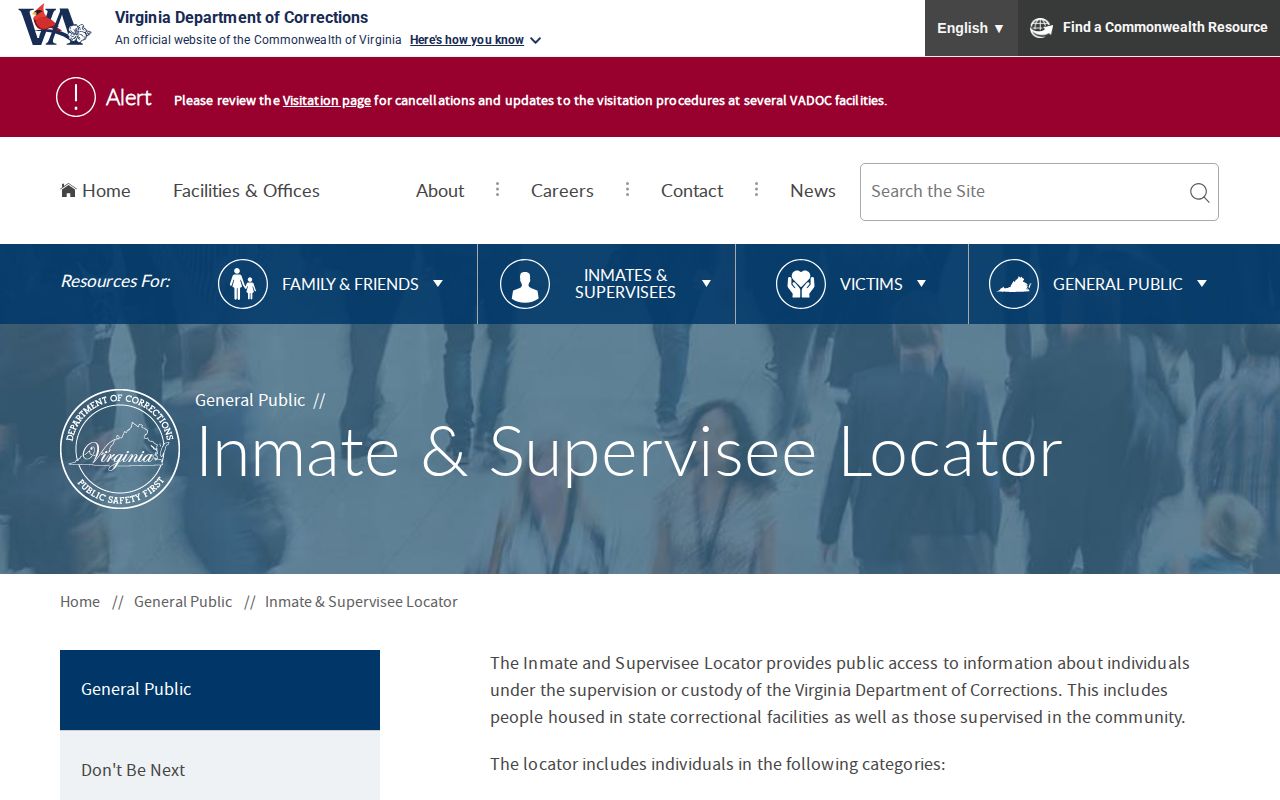
The locator may cover a prison, local bed under VADOC authority, CCAP, or community supervision, so the location must be read with the date.
Franklin Release-Day Date Checks
Even a well-supported projected date must survive release-day review. VADOC's facility-release process covers identity, release authorization, orders, warrants and detainers, personal property, funds, medication, clothing, documents, and transportation. A hold discovered or received during that review can prevent return to the community. The date field alone cannot show that the gate process finished.
VADOC release material identifies formal papers and the distinction between anticipated and actual release. When probation or parole follows, conditions and reporting information may accompany departure. A person can therefore be out of prison while still under District 37 supervision. That is a release from incarceration, not full discharge from every legal duty.
Local jail releases need the same distinction. Franklin County Jail or WVRJ may end its episode by bond, time served, sentence completion, or transfer. Ask for the actual separation entry and destination. If the date was calculated by WVRJ Records, that unit remains the right source for the local computation even though the underlying sentence came from a Franklin court.
The VADOC facility-release page shows the state release-day framework.
The official checklist explains why the projected date and the completed departure remain separate record events.
Transportation plans and release papers are practical clues, but they do not override a new warrant, detainer, or corrected order. Confirm the destination after departure. If District 37 appears next, read it as community supervision and seek a later discharge record when the question is whether all supervision ended. Record the actual date from the completed release document, not from an earlier estimate, family plan, or unofficial calculation.
Virginia Credits for Franklin Sentences
Virginia uses different credit frameworks based on offense date, offense type, and statutory eligibility. VADOC describes Good Conduct Allowance as generally applying to felony offenses committed before January 1, 1995 and misdemeanors committed before July 1, 2008. Depending on class, the older framework can range from no credit to 30 days for each 30 days served under §§ 53.1-198 through 53.1-202.
Earned Sentence Credits generally apply to felony offenses committed on or after January 1, 1995. Virginia Code § 53.1-202.2 and §§ 53.1-202.3 through 53.1-202.4 define classifications, rates, application, and offense limits. VADOC distinguishes sentences limited to zero through 4.5 days of credit per 30 days served from eligible enhanced-credit sentences that can earn up to 15 days per 30 days, depending on class and eligibility.
The common “serve 85 percent” phrase comes from the maximum 4.5-day credit rate in a restricted post-1995 framework. It is not a universal Franklin County formula. Mandatory minimums, offense eligibility, jail credit, consecutive terms, credit class, forfeiture and restoration, and added sentences can all change the result. A homemade calculator can miss those facts.
Credit rules also depend on the sentence information received by the calculator. A jail-credit entry reflects verified time already spent in qualifying custody. Consecutive terms run one after another, while concurrent terms may run together as the controlling orders provide. A mandatory minimum or an offense excluded from enhanced credits can keep a rough percentage estimate from matching the official date. The correctional records unit must apply the orders and statutes to the complete sentence package.
Open the VADOC Time Computation page for the current official explanation.
The official source explains both the credit systems and the division between local and state calculation responsibility.
Why Franklin Release Dates Move
A projected date changes when the responsible records unit receives or processes facts that affect the computation. Administrative display lag can also make a public value trail the underlying record. A changed field does not by itself show an error.
| Factor | Possible effect |
|---|---|
| Corrected court order | Changes the term or structure used |
| Prior custody credit | Adds verified time already served |
| Consecutive or concurrent terms | Changes how multiple sentences combine |
| Credit class change | Alters the rate going forward |
| Forfeiture or restoration | Removes or returns earned credit |
| New sentence | Adds another term for calculation |
| Detainer or warrant | May prevent community release after one term ends |
| Administrative update | Brings the display in line with processed records |
A detainer is a request or notice that another authority may take custody. On release day, VADOC checks identity, orders, warrants and detainers, papers, property, funds, medication, clothing, and transportation. A late hold can stop community release even when the displayed term reaches its expected end.
A corrected sentencing order can move the date in either direction. Prior custody credit may reduce the remaining term once verified, while an added consecutive sentence can extend it. Credit forfeiture after discipline can also change the projection, and later restoration can change it again. The public field may trail those actions until the correctional records system processes them.
For a local Franklin County sentence, ask whether the calculation includes every file-stamped order and all verified jail credit. For a state-responsible term, use VADOC's calculation. A clerk-certified order is necessary evidence, but the clerk does not perform the correctional computation or clear a detainer held by another agency.
Note: Ask which factor changed rather than assuming that every shift reflects lost good time.
Confirm Franklin Actual Release
For a local or regional jail event, Virginia Jail VINE may provide a supported custody-change notice. The Franklin County VINELink check explains person matching, the PIN step, and why a transfer can appear as release from one reporting agency. Use the jail's final entry for permanent proof.
For state custody, VADOC distinguishes anticipated release from actual release. Formal papers can include an Order of Release and Conditions of Probation or Parole when applicable. A move from an institution result to District 37 strongly suggests incarceration ended and community supervision began, but it does not mean full sentence discharge.
A fully discharged person may eventually stop appearing in the public locator. That absence does not supply an actual release date. VADOC Operating Procedure 010.3 permits customer-service confirmation of projected release information at the time of inquiry, while offender-record procedures identify certain projected parole, mandatory-parole, and good-time facts as public-facing under their rules. Those are status facts, not substitutes for the signed release record.
Parole dates need careful labels. A parole eligibility date only marks when review may become possible under applicable law. A Parole Board grant is a decision step, not the date the person walked out. The sound sequence is eligibility, review, decision, release planning, actual VADOC departure, and supervision if imposed.
Virginia abolished discretionary parole for most felony offenses committed on or after January 1, 1995, subject to statutory exceptions. Older parole-eligible sentences, mandatory-parole concepts, and geriatric conditional release follow different authorities. None should be folded into the earned-credit calculation as if they were the same route to release.
Who Calculates Franklin Release Dates
WVRJ Records calculates locally responsible sentences. Its annual report also says the unit sends state-responsible paperwork to VADOC for calculation and eventual transfer. This local/state split is the most useful Franklin County routing rule.
| Custody or sentence | Responsible date source |
|---|---|
| Pretrial detention | No fixed sentence date; use court and jail status |
| Local sentence at Franklin Jail | Franklin jail records/time calculation |
| Local sentence at WVRJ | WVRJ Records |
| State-responsible sentence | VADOC time computation and locator |
| Parole review | Virginia Parole Board for decision; VADOC for departure |
The court clerk can furnish the sentence order. The correctional records unit applies custody credits and the operative rules. Asking the correct unit reduces conflicting estimates and keeps a local jail sentence from being confused with a VADOC calculation.
WVRJ's role also explains why a person can have a Franklin County case but no VADOC projected field yet. Locally responsible time remains with the jail calculator. State-responsible paperwork must be sent to VADOC and processed for transfer and computation. During that transition, the court order, WVRJ calculation, and later VADOC record may reflect different stages rather than a true conflict.
If the person remains pretrial, do not force the case into either sentence table. Bond can change, charges can be amended, and another hold can remain. The proper sources are the current court order and jail custody record until a sentence creates a term for the responsible correctional unit to calculate.